-
News & Events


In January 2024, we visited a German university hospital on a business trip. During an internal meeting at the hospital, a leading German neurosurgeon shared with us longstanding concerns regarding Dr. Bertalanffy’s practice of performing high-priced overseas surgeries, particularly in developing countries.
Dr. Bertalanffy was born on 5 April 1954 in Timișoara, Romania, and is therefore not German by nationality. He is now 72 years old. According to our understanding, professors at German university hospitals and public hospitals generally stop serving as primary surgeons after the age of 69. Over the past several decades, Dr. Bertalanffy has reportedly worked as a “fly-in surgeon”-- an overseas surgeon is invited to another hospital solely to perform operations before returning to his home institution-- in developing countries, allegedly taking advantage of information asymmetry together with local neurosurgical department heads to charge patients exceptionally high surgical fees.
In Germany, however, he is regarded as an ordinary physician rather than one of the country’s leading neurosurgeons. He has never held a W3 professorship, has never served as President of the German Society of Neurosurgery, and is not affiliated with a German university hospital. Therefore, in our view, the public portrayal of him as one of Germany’s leading neurosurgical authorities is misleading.
Over the past eight years, Dr. Bertalanffy has increasingly carried out surgical procedures in China. At a Class III Grade A hospital in Suzhou, a single operation performed by him as reportedly been priced at as much as RMB 820,000. During the hospitalization, patients are also required to pay an additional RMB 50,000 to the hospital.
This raises an important question: what justifies such pricing?
According to information provided to us by the President of the German Society of Neurosurgery, even the most expensive surgeries of this type performed at German university hospitals cost approximately €40,000 in total (around RMB 320,000). These charges are generally covered in full by Germany’s statutory or private health insurance, meaning that German patients usually pay nothing out of pocket. The total cost includes hospitalization, surgery, anesthesia, examinations, medications, nursing care, and meals throughout the hospital stay.
For surgeries of this complexity, the lead surgeon typically receives professional compensation of approximately €3,000-5,000 (roughly RMB 24,000-40,000) per case.
The Key Issue: Under Chinese law, only hospitals and medical institutions holding The Practice License of Medical Institution are legally authorized to provide medical treatment, perform surgical procedures, and charge patients for such services. A medical intermediary company based in Shanghai-- or any of its branch offices-- is not a licensed medical institution. This raises another question: on what legal basis can such companies publicly sign treatment contracts with patients and charge as much as RMB 820,000 for a single operation?
Mr. Chen from Shangrao, Jiangxi Province, was referred on December 1, 2025 by Director Xiao of a Class III Grade A hospital in Suzhou to Ms.Zheng, a sales representative at the Wuhan branch of a Shanghai-based intermediary company.
On December 3, 2025, the company signed a contract with Mr. Chen and collected RMB 820,000 for the surgery. The intermediary informed him that the fee would increase further if Dr. Bertalanffy were invited to perform the surgery again in 2026.
Director Xiao effectively endorsed the intermediary through the credibility of the public Class III Grade A hospital where he worked. Exploiting the patient’s desire to survive and the family’s desperation to save him, the three parties, in our view, placed enormous financial pressure on Mr. Chen, leaving him no choice but to sell family assets and borrow money from relatives.
Before the surgery, Mr. Chen transferred RMB 820,000 to the intermediary company. Ultimately, he became entirely dependent on the arrangement established by these three parties and was left with little bargaining power. The contract signed with Ms. Zheng primarily protected the interests of the intermediary company rather than those of the patient.
The Shanghai-based intermediary company reportedly employs only around 20 staff members, yet has established 12 branch offices across China. Most of these branches have registered capital of only RMB 100,000, meaning that, from a legal perspective, their liability is generally limited to that amount.
According to our findings, many of these branch offices have not enrolled any employees in China’s social insurance system. Using branch offices to sign contracts with patients also serves to isolate legal and financial risks. In case a dispute arise, and individual branch can simply be abandoned. This structure may also facilitate fund withdrawals and reduce tax liabilities.
According to statements published by the intermediary company on its official Wechat account in 2025, Dr. Bertalanffy had performed more than 200 surgeries over a seven-year period at the neurosurgery departments of three Class III Grade A hospitals located in Suzhou and Beijing. Assuming an average charge of RMB 700,000 per surgery, the total amount collected from patients would exceed RMB 140 million.
Sales representatives from the intermediary company’s branch offices have also reportedly informed patients that prices increase every six months. Their charges reportedly include:
l Email Consultation: RMB 25,000 each
l Video consultation: RMB 38,000 each
l In-person consultation: RMB 31,000 each
l Follow-up consultation: RMB 4,000 each
According to our understanding, the company derives substantial revenue not only from surgical arrangements but also from a wide range of consultation services.
Over the past seven years, Dr, Bertalanffy has reportedly performed more than 200 surgeries at three Class III Grade A hospitals in China. This raises an important question: Why, after seven years, has no neurosurgeon at these hospitals independently undertaken this type of operation? Why has the same overseas surgeon repeatedly been invited to perform these surgeries?
In our opinion, the reasons may include the following.
1. If a physician is genuinely among Germany’s leading neurosurgical experts, it is generally difficult for them to travel overseas frequently, as their responsibilities at German university hospitals are typically demanding and leave very limited availability. By contrast, physicians with fewer ongoing clinical commitments may be much more readily available for overseas surgical invitations.
2. In our assessment, Dr. Bertalanffy has not occupied a central leadership position within Germany’s neurosurgical academic community.
3. Outside Germany, he has reportedly collaborated with physicians such as Director Xiao while being promoted as a “leading German expert,” enabling exceptionally high fees to be charged to patients. In our opinion, this represents a business model centered on the commercial value of reputation rather than medical necessity.
4. Sales representatives from the Shanghai intermediary company consistently describe Dr. Bertalanffy on their video channel as a “top German expert.” Whether such descriptions accurately reflect his professional standing in Germany is, in our view, open to serious question. We believe this promotional strategy relies heavily on information asymmetry between patients and medical providers.
5. If these operations were instead performed by neurosurgeons employed directly by these Chinese Class III Grade A hospitals, the charges would generally follow China’s standard medical insurance pricing system, and the payments would be made directly into the hospitals’s official accounts. Under such circumstances, the intermediary company would no longer play a central financial role. In our opinion, the continued reliance on an overseas visiting surgeon enables the intermediary to charge patients fees substantially higher than those normally associated with comparable surgeries.
6. As a result, the substantial surgical fees paid by patients may ultimately be shared among multiple parties involved in arranging these surgeries. After eights years, this has, in our view, developed into a highly profitable yet largely hidden commercial chain. All three parties involved have benefited financially from patients’ final efforts to pursue life-saving treatment. Most patients and their families do not have a medical background and therefore rely heavily on the information provided to them. As a result, many patients may pay exceptionally high fees without fully understanding how those charges compare with the actual costs of similar procedures elsewhere. Even after surgery, some patients remain deeply grateful, believing that those involved were the ones who saved their lives. Based on the pricing described above, the fee charged for a single surgery was approximately 34 times the professional fee typically paid to the lead surgeon for a comparable surgery in Germany. In our opinion, the surgery itself is not uniquely difficult, and many experienced neurosurgical department directors at leading Chinese Class III Grade A hospitals are fully capable of performing surgeries of comparable or even higher technical quality than Dr. Bertalanffy.
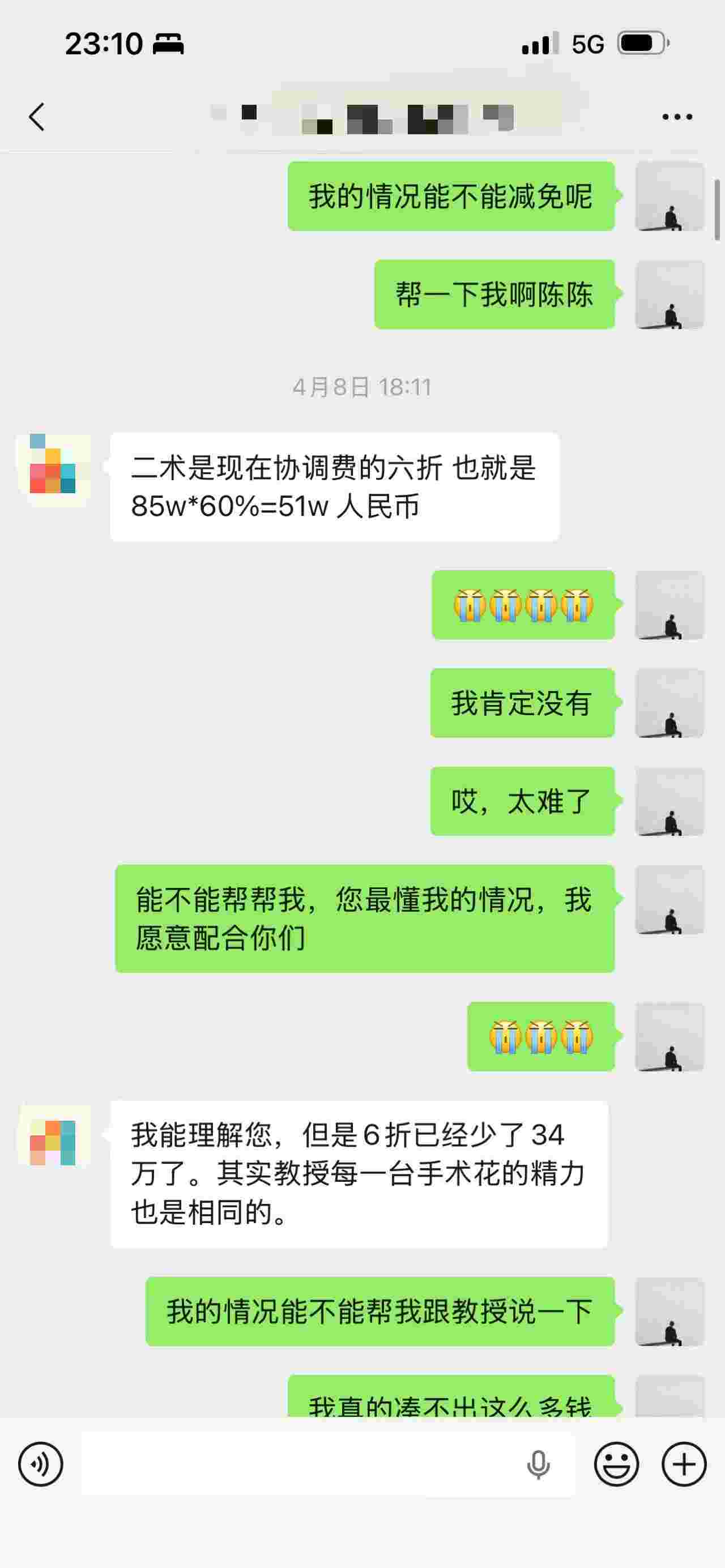
Although Mr. Chen’s surgery was unsuccessful and he had already exhausted his financial resources, Ms. Zheng from the Wuhan branch of the intermediary company reportedly recommended that he undergo a second surgery. According to Mr. Chen, she stated that the company had already offered him a 40% discount, yet the proposed treatment would still require an additional payment of RMB 510,000.
Mr. Chen repeated appealed for help but was unable to find an effective solution. Two weeks ago, he turned to the Gloryren team for assistance. According to our understanding, Director Xiao has shown little willingness to acknowledge responsibility.
In our view, Mr. Chen has suffered both devastating financial losses and an unsuccessful medical outcome. We believe this case has moved far beyond the original purpose of providing medical care. Throughout the process, Dr. Bertalanffy has remained largely absent from direct communication with the patient. In our opinion, it is ultimately his professional reputation that has been used to justify the exceptionally high surgical fees charged to the patients. This therefore raises a fundamental question-- who has made it possible for a single surgery performed by Dr. Bertalanffy to be priced at RMB 820,000?
Chinese patients often face life-threatening illnesses with an overwhelming desire to survive. Having become aware of these circumstances, we believe that remaining silent would mean overlooking what we consider to be a matter of significant public concern.
We therefore call upon the relevant healthcare regulatory authorities to investigate these practices promptly, strengthen oversight where necessary, and better protect patients. In our view, this issue extends beyond a single medical case. It reflects broader challenges concerning transparency, regulation, and the governance of healthcare services.
A nation ultimately benefits from scientific innovation, advanced medicine, accessible education, social stability, and a society governed by the rule of law. These, we believe, are the foundations that deserve the greatest attention.