-
News & Events


In recent years, a growing number of so-called “regulated companies” have emerged in China’s medical industry. However, those are neither the regular hospitals nor any other regulated medical institutions. They promote services under labels such as “International Medical Care”, “Overseas Expert” and “the World’s Leading Professor”, but actually it’s false advertising. Behind these claims lies an extremely expensive and non-transparent commercial chain operating between Chinese hospitals and patients.
One company is a typical example of this. On its official website, it describes itself as an “international neurosurgeons’ group” claiming to include “giants” in the field of neurosurgery from the United States, Germany, Japan, France, Italy and other countries. What’s more, it also boasts that it is equipped with so-called “international advisory boards” and “international expert panels”, whose members include “president-level figures of international societies” and “world-renowned masters whose names are attached to surgical procedures and anatomical structures in textbooks.”
This kind of advertising can be highly persuasive for patients and their families, especially for those who suffer from high-risk diseases such as brain tumors, cerebrovascular diseases, and pediatric neurosurgical disorders. Due to their anxiety and fear, they would be easily taken in by the company’s fine-sounding rhetoric such as “the best in the world”, “globally unique”, “only achievable with the involvement of overseas professors” and are convinced that there must be better chances of beating the disease as long as they spend more money.
But the point is that what they said is not their concerns for patients, not for the medical care, but merely to make a profit.
First, a basic question must be asked: who is legally authorized to charge patients for medical services?
Publicly available information shows that the company’s registered business scope primarily includes “hospital management” “technical consultation” “conference services”, “translation” and “medical device sales”, etc., but it’s not a licensed medical institution. In accordance with China’s current law and regulations, only hospitals or medical institutions with the Practice License of Medical Institution are qualified to provide diagnosis and treatment services and charge patients for medical services.

In other words, such a company can provide services such as translation, coordination of events, supporting academic exchange activities and assisting hospitals to invite experts . However, it cannot serve as a medical treatment provider, let alone directly charge patients for so-called “consultation fees”, “surgical fees” or “expert fees”.
Yet in reality, this company has long centered its business around a certain German neurosurgical expert. For example, a single email inquiry, a video consultation, or an in-person visit costs 20,000 to 30,000 CNY. If the expert operates in person, patients must pay an additional fee of around 700,000 to 800,000 CNY, or even as much as 1 million CNY. However, none of this is conducted through a hospital’s official billing system.
The problem is: What’s the basis for charging such “surgical fees” amounting to hundreds of thousands of yuan? Why do Chinese patients undergoing the exact same surgery have to pay an extra several hundred thousand yuan simply because of the involvement of a “foreign expert”? And are these fees paid to the hospital, or a private company?
More alarmingly, such price is far beyond the normal medical charging standards.
Whether Chinese or foreign experts, when performing surgeries in Chinese hospitals, medical fees must comply with the regulations set by the National Healthcare Security Administration(NHSA) and relevant pricing authorities. Doctors may participate in clinical practice as a visiting professor, but they can not operate outside the hospital’s official billing system and independently charge patients hundreds of thousands of yuan for so-called “surgical fees.”
Nor is this how medical billing works in Germany. For complex neurosurgical procedures, German public hospitals generally adopt an all-inclusive charging model, covering surgery, anesthesia, hospitalization, nursing care, and other related services. The total cost is often around 20,000 euros, equivalent to roughly 170,000 CNY. Yet in China, patients are forced to pay an extra surgical fee around 700,000 to 800,000 CNY just because a certain foreign professor is involved. This is not international cooperation, but a form of internationally driven price gouging.
Yet the German expert, who has long been promoted by the company as an “international neurosurgical giant” and a “president-level figure in world neurosurgical societies,” also appears to differ significantly in reality from how he is portrayed in the promotional materials.
According to public information, this expert was born in 1954 and is now 72 years old. Under Germany’s current retirement system, the statutory retirement age is generally 67. Even with deferred retirement, it rarely exceeds 69. Within the university hospitals and public hospital system in Germany, most professors and department heads of neurosurgery, after retirement, mostly take on teaching, academic consulting and supervisory roles, rather than continuing to perform high-intensity and high-risk surgeries.
The problem is not age itself, but rather: Has the company properly informed Chinese patients of this fact in its promotions? Did patients know, before paying hundreds of thousands of yuan, that this “international leading expert” has long since ceased to be in typical frontline clinical practice within Germany’s own healthcare system?
In addition, the company’s promotional materials repeatedly use phrases such as “president-level figure” and “President of the International Neurosurgical Society”. However, the public resumes show that the expert once headed the Education and Technical Committee and the Nominating Committee under the World Federation of Neurosurgical Societies, rather than serving as president of the federation as a whole. He has also never served as president of the German Society of Neurosurgery, the most authoritative professional organization for neurosurgery in Germany.
This does not mean his academic experience is without value, but it does mean that the titles used in commercial promotion have been significantly exaggerated.
Likewise, the institution where he holds a position in Germany is not a German university hospital or large public hospital, but a private neurosurgical institution serving international and self-paying patients. There is nothing wrong with such an institution in itself. However, when it is marketed as a “national-level neurosurgical center in Germany” or “Germany’s most authoritative hospital”, it goes beyond objective description and becomes marketing.
What’s worse, this model does not merely charge patients but actively build a referral chain.
Public recruitment information shows that this company has long been seeking to hire so-called “senior medical liaison coordinator” and “high-end medical service consultant” with “sales experience in servicing high-net-worth clients”. Their core responsibilities include: Liaising with neurosurgeons at tertiary hospitals, maintaining “client relations” with doctors, encouraging doctors to refer complex cases to the company, converting patient inquiries into orders via phone, Wechat and social media, and continuously improving consultation-to-sales conversion rates.
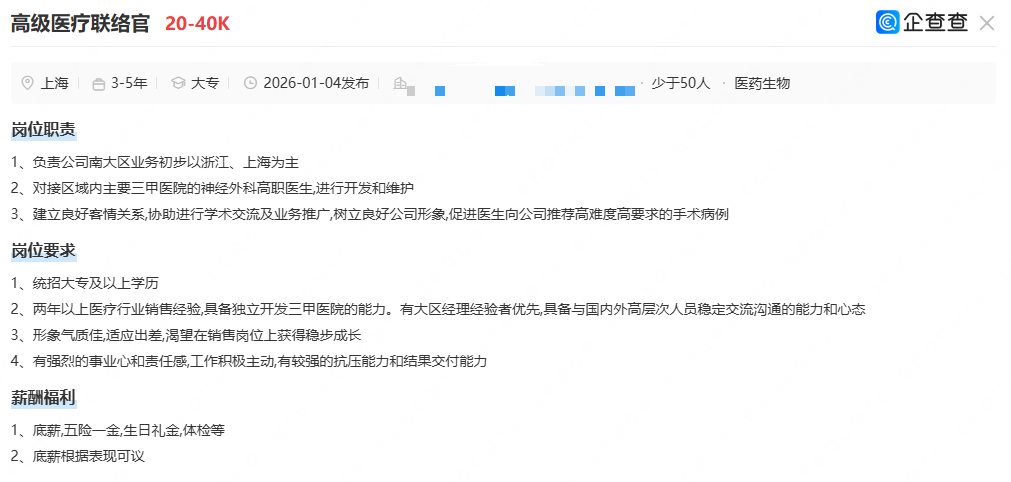
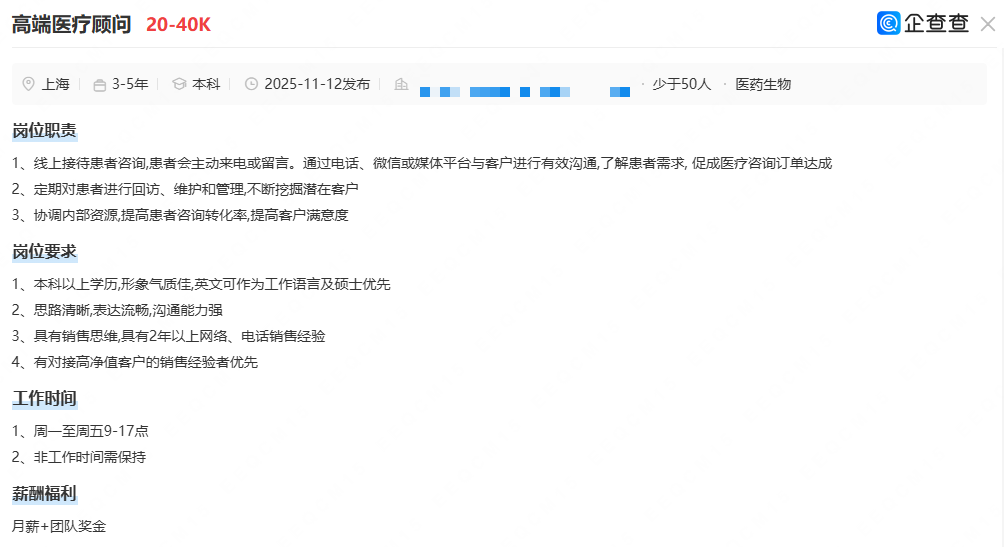
To be more straightforward, this involves persuading certain doctors to refer patients who should be treated within hospitals and under the standard medical system to the company instead. This is what is most disturbing.
Nowadays, the gap in neurosurgical field between the large Grade Three Class A hospitals in China’s cities and Europe and the United States has been significantly narrowed. In both first-tier cities and many second-tier cities, neurosurgeons practice in accordance with the international guidelines, and the vast majority of conditions can be treated domestically.
Therefore, there is simply no such scenario as “only a professor in Beijing can perform this” or “only a certain German expert can do this.”
What drives patients to believe that “consulting a foreign professor is a must” is not based on medical considerations, but on marketing.
Especially for families of pediatric patients and those with rare diseases, who are at their most desperate moments, they are easily take in by their fine-sounding rhetoric such as “Delaying expert care will be too late” or “He is the only one in the world who can do this.”
As a result, the anxiety is gradually converted into expensive orders.
However, the true international cooperation should not be like this.
Instead, it should be that foreign professors come to China and conduct outpatient clinics, discuss treatment plans and supervise surgeries alongside Chinese teams, sharing their expertise with Chinese doctors. In this way, patients can receive treatment in local regulated hospitals at a standard price.
In-service professors of German university hospital we cooperated with never charge extra fee from patients during their visit in China. They discuss treatment plans together and provide surgical guidance to Chinese teams. All of the patient’s expenses are settled through the hospital’s regular billing system. Patients pay exactly what is required, no more, no less. There are no “foreign expert fees” and no “international expert price gouging”. Because true medicine has no need for myths and hype.
What Chinese healthcare needs to reflect on is not why there are not more “international medical intermediary companies” , but why so many patients and doctors are willing to believe that “foreign experts” are more skilled than Chinese doctors.
As long as such false narrative exist and those companies profit from patients’ fear and anxiety, there will always be those in the Chinese healthcare sector who treat illness as business and lives as orders.
The most important thing for healthcare is the fairness. Whether rich or the poor, they should be treated equally when they come to the hospital for medical treatment.
All in all, the essence of medicine is in kindness, compassion, and care.