



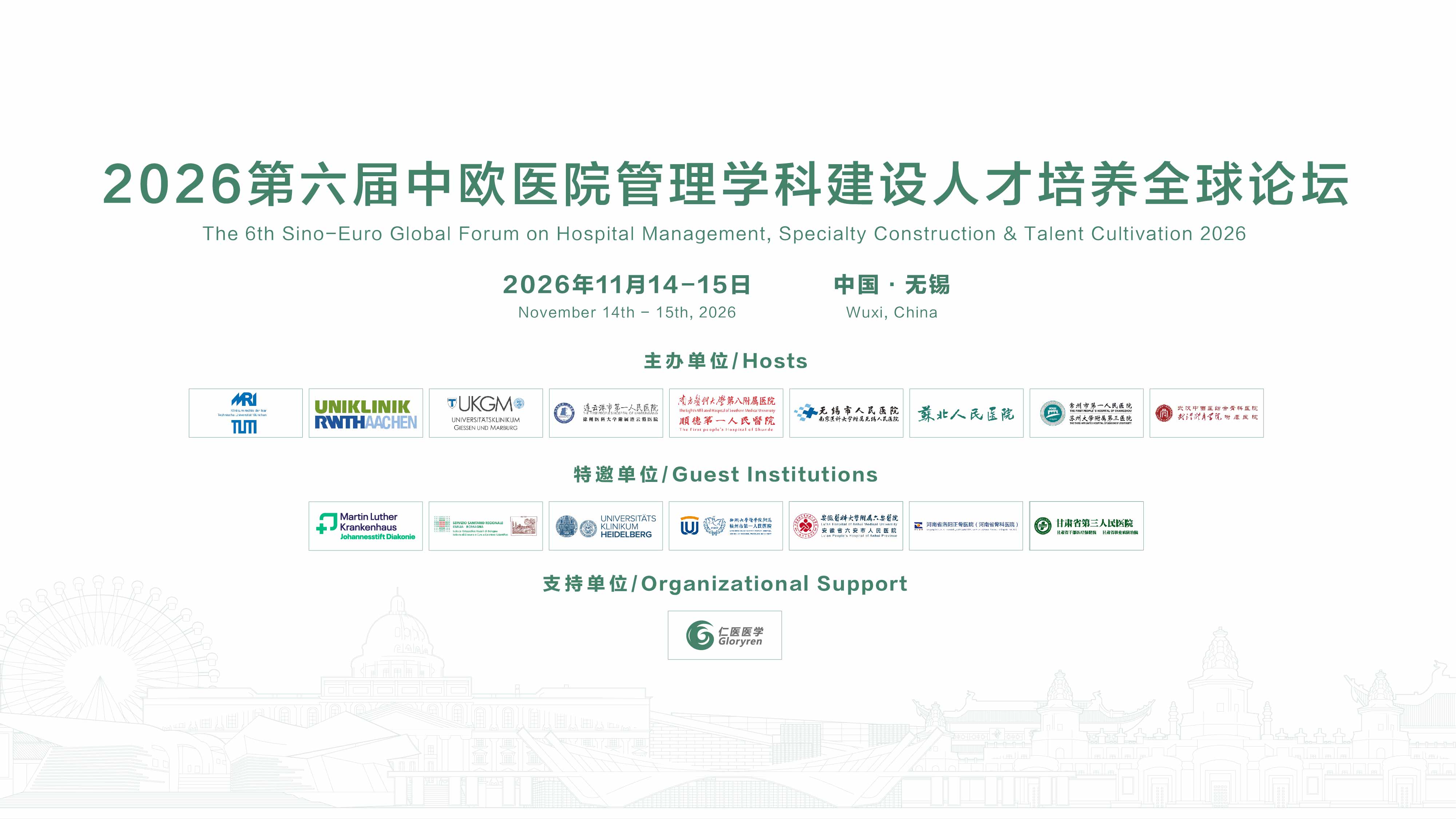
Agenda for November 14th
11:00-18:00
Registration
Location: Dangkou Ancient Town Hotel Wuxi MGallery Collection First Floor Academy Foyer
17:00-17:30
Internal Pre-meeting of Faculty of SEOS 2026
Location: Dangkou Ancient Town Hotel Wuxi MGallery Collection Second Floor Zi Qian Meeting Room
17:30-17:50
Faculty Members’ Signatures and Group Photo
Location: Dangkou Ancient Town Hotel Wuxi MGallery Collection First Floor Academy Foyer
18:00 - 21:00
Welcome Banquet of the SEOS 2026 Global Press Conference
Location: Dangkou Ancient Town Hotel Wuxi MGallery Collection First Floor Academy Ballroom
Agenda for November 15th
08:30-12:00
The 6th Sino-Euro Global Forum on Hospital Management, Specialty Construction & Talent Cultivation 2026
Location: Dangkou Ancient Town Hotel Wuxi MGallery Collection First Floor Academy Ballroom
12:00-14:00
Closing Ceremony of the SEOS 2026 Global Press Conference
Question List Sino-Euro Forum 2026
Session 1: Hospital Management
8:40-9:40
1. The core value of healthcare lies not only in hospital size, technological advancement, and academic strength, but also in the establishment of trust-based healthcare. How can hospital leaders build and maintain long-term trust among patients, healthcare professionals, and hospital management team?
2. China’s national health strategy under the 15th Five-Year Plan propose a shift in hospital development from expansion of scale to improvement of quality. What quality management experiences from German hospitals could be valuable for China? How can hospital leaders establish a development model truly centered on medical quality?
3. With the rapid advancement of digital healthcare, including AI-assisted diagnosis, nationwide medical imaging data sharing, and electronic health records, how can hospital leaders balance the efficiency gains brought by artificial intelligence with issues of patient safety and physicians’ responsibilities?
4. With the continued implementation of DRG/DIP-based payment reforms, hospitals are facing increasing pressure to control costs. How can hospitals ensure the sustainable development of innovative technologies, advanced medical equipment, and high-quality healthcare services under these circumstances?
5. In the future, more patients will receive initial diagnosis, chronic disease management, and rehabilitation at the primary care level. How should Grade Three hospitals redefine their role and establish effective collaboration with primary healthcare providers? What experiences from Germany’s tiered healthcare system can be shared?
Session 2: Specialty Construction (Orthopedics and Trauma Surgery)
9:40-10:40
1. With the continuous development and specialization of orthopedics, how can hospitals build internationally competitive orthopedic subspecialty sections? Given limited resources, should hospitals prioritize comprehensive orthopedic or focus on developing specialized centers of excellence?
2. Orthopedic oncology is a highly interdisciplinary field integrating orthopedic surgery, oncology, pathology, radiotherapy, and medical imaging. How can hospitals establish an internationally recognized orthopedic oncology center?
3. In an aging society, the number of patients with bone metastases, osteoporosis-related fractures, and complex reconstruction needs continues to increase. How should orthopedic subspecialties adapt their future development strategies to address these changing disease patterns?
4. With the rapid development of technologies such as artificial intelligence, 3D printing, navigation, and surgical robotics, how can these innovations be integrated into clinical practice in a meaningful and evidence-based way?
5. What are the key factors that define the competitiveness of a world-class orthopedic center: complex surgical expertise, original research, clinical translation, or international collaboration? Should different orthopedic subspecialties adopt different development priorities?
Session 3: Talent Cultivation
10:40-11:40
1. Many young doctors today face long-term challenges, including night shifts, heavy clinical workloads, and research pressure. How should hospitals redesign their training systems to support young doctors’ professional development while maintaining their passion for medicine?
2. How to establish a more comprehensive and balanced evaluation system for young doctors, rather than relying excessively on research metrics such as publications and journal impact factors?
Notes for Q1 and Q2:
3. In the era of artificial intelligence, what core abilities should young doctors focus on developing that cannot be replaced by AI? Does medical education need to evolve accordingly?
4. As medicine becomes increasingly international, what global competencies should young doctors develop beyond clinical skills? What role can international exchange, overseas training, and cross-cultural collaboration play in their career?
Notes for Q3 and Q4:
5. Gender disparities still exist in medicine and academia. How can we support more outstanding female physicians and researchers in advancing to leadership positions? What successful experiences from German university hospitals can be shared?